
Interactive Session on Heatwaves, Health Risks & Weather Reporting calls for community-driven heat governance, responsible media reporting, and climate-health preparedness

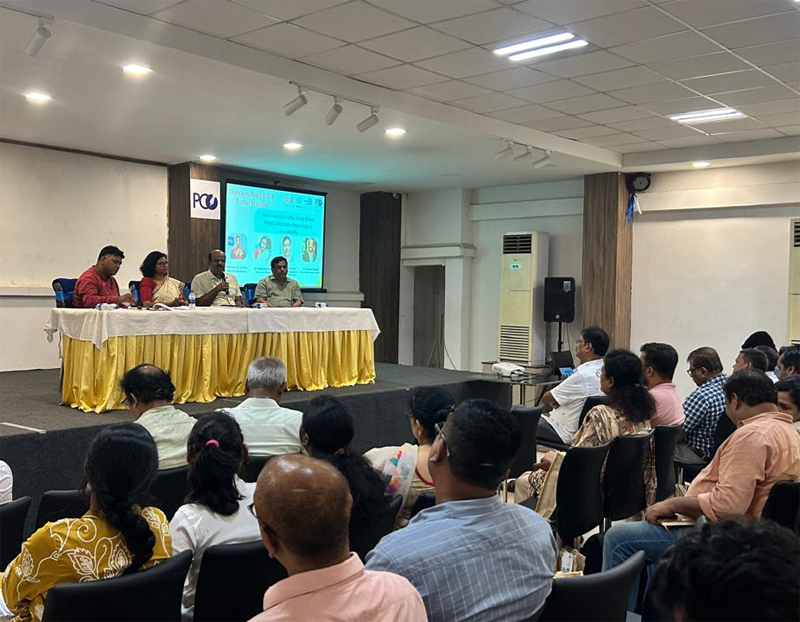
Bhubaneswar | 27 May 2026: An interactive session on “Heatwaves, Health Risks & Weather Reporting” was organised today at the Press Club of Odisha, Bhubaneswar by Press Club of Odisha, Socratus Foundation for Collective Wisdom, Odisha Environment Congress, and Asar Social Impact Advisors. The workshop brought together journalists, climate experts, scientists, public health professionals, civil society organisations, and media practitioners to discuss the growing challenges posed by heatwaves and the need for responsible and informed reporting on heat-related risks.
The event began with opening remarks by Virat Singh from ASAR Social Impact Advisors and Siddhant from Socratus Foundation, who highlighted the increasing urgency of addressing heatwaves not merely as weather events, but as interconnected climate, health, governance, and livelihood challenges.
The workshop featured two expert technical sessions followed by a panel discussion involving experts from meteorology, climate governance, media, and public health.
Prof. Debadatta Swain from IIT Bhubaneswar spoke on the scientific understanding of heatwaves and explained the difference between actual temperature and felt temperature. He highlighted how extreme heat affects the human body, including the body’s reduced ability to cool itself during prolonged heat exposure. He explained that the heart pumps more blood in an attempt to cool the body, increasing palpitation and the risk of heatstroke. He also discussed the difference between Wet Bulb Temperature and Dry Bulb Temperature and stressed that many slow and cumulative impacts of heat on health are often neglected in public understanding.
Dr. Ashutosh Acharya from Aurassure presented data and visualisations showing how increasing urbanisation and concretisation have significantly increased temperatures across different wards of Bhubaneswar. He discussed the Urban Heat Island effect and highlighted how journalists can use data, visualisation tools, storytelling techniques, and hyperlocal narratives to better communicate heat-related risks and vulnerabilities to the public.
The panel discussion featured Dr. Manorama Mohanty, Director of India Meteorological Department (IMD), Bhubaneswar; Dr. Arabinda Mishra, Chairperson of Development and Environment Futures Trust; and Mr. Bhabani Tripathy, Group News Editor of Sambad & Kanak News. The session was moderated by Anuj Das from Kanak News.
During the discussion, the panel emphasized that Heat Action Plans should move beyond being only “temperature response documents” and evolve into integrated climate-health-risk management frameworks. Speakers stressed that preparedness systems should be decentralized and community-driven, especially as extreme weather events such as thunderstorms, lightning, hailstorms, and localized heat events continue to involve forecasting uncertainties.
Participants highlighted the need for Civil Society Organizations (CSOs), universities, technical institutes, public health institutions, youth groups, and local community networks to become institutionalized implementation partners in Heat Action Plans rather than being consulted only during emergencies.
The discussion also emphasized the importance of hyperlocal vulnerability mapping at ward and panchayat levels to identify vulnerable groups including outdoor workers, elderly persons, children, homeless populations, urban poor communities, and persons with disabilities.
Dr. Arabinda Mishra highlighted that the impact of heat on children differs significantly, often resulting in blisters, rashes, sleep disruption, and cognitive stress. He also pointed out that the reducing gap between day and night temperatures is affecting recovery from heat exposure and impacting children’s intellectual growth and well-being.
The panel collectively stressed that outside workers such as construction workers, sanitation workers, delivery workers, street vendors, farmers, and informal labourers are among the most exposed to heat stress and heatstroke due to prolonged outdoor exposure.
Mr. Bhabani Tripathy emphasized the need for multi-actor platforms in both policy making and implementation. He stated that Heat Action Plans should not remain limited to administrative structures alone but should actively involve academicians, scientists, practitioners, CSOs, media institutions, and community stakeholders to develop more comprehensive and practical heat governance systems.
The panel also highlighted the importance of strengthening Panchayats as local decision-making and administrative units for heatwave preparedness and broader climate governance.
Dr. Manorama Mohanty from IMD stressed the importance of responsible reporting and cautioned against fear-based communication that may create unnecessary panic among the public. She highlighted the regular advisories, weather station monitoring systems, heat alerts, and preparedness guidelines issued by IMD and called for stronger coordination between scientific institutions and media organisations to improve public awareness and risk communication.
Across the sessions, participants agreed that language and communication play a critical role in journalism around heat and climate risks. Speakers emphasized that media reporting should create a sense of public responsibility and awareness without sensationalism. They stressed the importance of culturally rooted communication methods, local analogies, and climate education approaches that make heat-related risks understandable and relatable to ordinary citizens.
The workshop also discussed the need for occupational heat safety protocols, climate volunteer cadres or “Heat Mitras,” public cooling infrastructure, shaded public spaces, drinking water kiosks, revised school timings during extreme heat conditions, and Urban Heat Island mapping for major cities.
A special screening of the short film “It’s Only 47°C,” produced by Naseeruddin Shah, was also held during the event. The film highlighted the unequal impact of heat on traffic personnel, gig workers, rickshaw pullers, farmers, homemakers, and other vulnerable groups whose livelihoods and health are directly affected by rising temperatures.
The workshop concluded with closing remarks by Sudarshan Das from Odisha Environment Congress, who emphasized the need for collaborative action, stronger public engagement, and long-term climate resilience planning to address the growing heat crisis across Odisha.
The organisers stated that the workshop aimed to strengthen media understanding of heatwaves, improve climate-health communication, and build stronger coordination between scientific institutions, governance systems, and journalists for responsible and people-centric heat reporting.
