

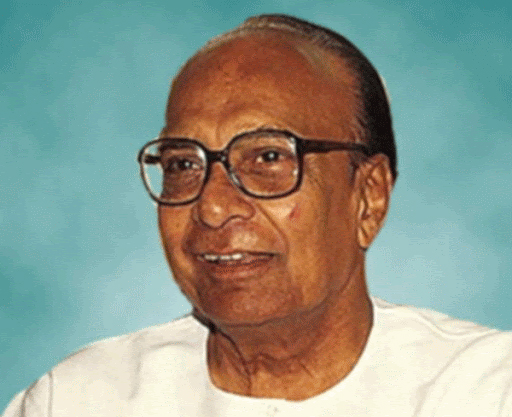
BIJU PATNAIK WAS NOT A CIA AGENT
Anil Dhir
Bhubaneswar 30th March : The BJP and its leaders indulge in opposition bashing using a bundle of half-truths, utter lies and inane inferences. The intellectual bankruptcy of the party has now surfaced by Nishikant Dubey’s foot in the mouth quip on Biju Patnaik. While speaking to reporters in New Delhi, he alleged that former PM Jawaharlal Nehru had fought the 1962 war against China with American money and in collaboration with CIA agents and named Biju Patnaik as a “link” between the US government, the CIA, and Nehru. He also said that Biju Babu was involved in helping CIA operate U2 planes at the Charbatia air base in Odisha. The real facts of Biju and his role as Nehru’s defense advisor has been mentioned in my book on Biju Patnaik.
The American Secret Agency CIA had always maintained an extensive dossier on Biju Patnaik. Numerous memoirs of ex-bureau chiefs, diplomats and operatives mention him in their works. The CIA maintained dossiers on leaders and politicians who were anti-communist and friendly to the USA.
Biju Patnaik’s role in setting up of the Aviation research Centre at Charbatia and his visit to the CIA headquarters find ample mention in Conboy and Morrison’s book “The CIA’s Secret War in Tibet”.
During the height of the Cold War years, in April 1963, US Ambassador Galbraith made the first official request to India for a base for the U-2 spy planes. In spite of intense and almost desperate persuasion by the USA, Nehru turned down the CIA proposal to base a detachment of the high-streaking snooper planes.
In March 1963, Biju Patnaik, as Nehru’s defense adviser, was sent to Washington. He held discussion with the Pentagon. The two interviews that he had given to the Washington Post and the Baltimore Sun caused a stir in the political circles back in India. There are reports that he had also secretly visited the CIA headquarters at Langley.
On 3rd June 1963, Kennedy met President Radhakrishnan at the White House and reiterated the CIA’s wish. After Radhakrishnan’s return, Nehru held a meeting with Biju Patnaik and discussed the matter. The Americans had lobbied with Biju, who was keen to have the base at Charbatia. Everything was set for the final go, but Nehru turned down the proposal at the last moment. A dejected Galbraith met Biju Patnaik, who by then had resigned under the Kamaraj plan.
Nehru’s objection was based on the advice of the IB Chief B.N.Mullick. Mullick asked Nehru to insist on having all the films shot by the spy planes processed in India and retaining one set of all the photographs. The CIA argued that each U-2 sortie brought back hundreds of miles of film and it was just not possible to set up the technical facility to process and analyse all of them in India. The CIA instead offered to give India processed pictures later, but Mullick would have none of it. Nehru struck to his guns, even after Biju Patnaik talked to him on the issue.
In May 1963, T.T. Krishnamachari, the powerful minister in Nehru’s Cabinet, visited the US, and the officials there had persuaded him to send a long cable to Nehru asking him to change his mind about the U-2 base. Nehru ticked him off with a curt “please do not meddle in this”.
A disappointed Galbraith left India in June 1963. He had lobbied hard with Biju to get the U-2 base through, but failed. Galbraith had made nearly half a dozen trips to Bhubaneswar, both secret and official, to meet Biju. During one of his trips, he was hosted at the BNR Hotel in Puri and signed the visitor’s book and praised the hotel.
Chester Bowles, the new Ambassador, had been briefed about Biju’s proximity to Nehru. Topmost on his agenda were two unfinished projects of Galbraith, the setting up of a Voice of America transmitter and the Bokaro Steel Plant. In 1963, eager to bolster its radio transmitting capacity against China, Nehru had agreed to locate a VOA transmitter somewhere in eastern India. On Biju’s insistence, Odisha was one of the places earmarked for the facility, even though the Americans wanted it in the North-east. The agreement was that the Americans would be allowed to maintain the facility for some limited hours, but Indians would control and run the show. In short, the Americans would be using Indian Territory for their propaganda broadcasts, something that was against the spirit of non-alignment.
When news leaked out, the Indian media and opposition raised a hue and cry. There were nay-sayers within Nehru’s Cabinet too. Biju Patnaik vehemently supported the project, but in the end Nehru cancelled the proposal under the flimsy pretext that the Americans were not agreeing to it being completely staffed by Indians. Nehru’s flip-flop resulted in America’s backing off from the Bokaro Steel Plant. Despite the fact that Kennedy was keen to give financial support for the steel mill, the U.S. Congress turned it down.
In November 1963, Chester Bowles was summoned by Kennedy to Washington. Bowles had met Biju Patnaik and the new Defence Minister Y.B. Chavan. Kennedy had agreed to a proposal for arms aid of $ 375 million, spread over five years. In his memoirs, Bowles has written that a pleased Kennedy had called him for a meeting on the 26th Nov, one day before he was to return to India. Kennedy told Bowles that he would be approving the aid plan. That meeting between the President and his Ambassador to India never happened, Kennedy was shot dead on the 22nd November 1963.
Biju Patnaik once again took up the Charbatia base matter with both Mullick and Nehru. A reluctant Nehru, on Biju’s insistence, agreed to allow the US to overfly Indian Territory and use Charbatia as a base for refueling the CIA’s U-2 spy planes. The CIA resumed its spy missions from Thailand’s Takhli air base. According to declassified documents on the history of the U-2 programme obtained under the Freedom of Information Act by National Security Archives of the USA, it was the secret flights made by these U-2s aircrafts which informed India about the nature of Chinese incursions inside Indian territory.
Biju Patnaik finally persuaded Nehru to allow the U-2 base at Charbatia after he had persuaded the Americans to set up a processing laboratory for the films that were shot by the spy planes. A huge complex with 30 air-conditioned flats was built for the nearly 60 CIA technicians, who worked round the clock. The complex still exists, and in later years, was used for processing pictures brought in by our own reconnaissance aircraft. Today, in this age of satellite technology, the setup has become redundant.
The first mission out of Charbatia took place on the 24th May 1964. Three days later Nehru died, and further operations were postponed. The pilots and the U-2 planes left Charbatia for Thailand, but the technicians remained. In December 1964, when Sino-Indian tensions along the border increased once again, Detachment G returned to Charbatia and conducted three highly successful missions. The role of the Americans spy planes during the Chinese debacle has never been told. The setting up of Establishment 22 in Charbatia, comprising the Khampa rebels and Biju Patnaik’s role in it is the matter of another chapter in this book.
How much credence the Americans gave to Biju Patnaik is evident from CIA and American Embassy papers released a few years ago. On 14th January 1964, a telegram from the American Embassy at Delhi, sent to the State Department, revealed that Nehru had suffered a coronary thrombosis resulting in partial paralysis. The next day Chester Bowles sent a detailed report on the rat race that erupted for the office of Prime Minister. He mentioned that the Krishna Menon-Madan Mohan Malaviya group was hell-bent on propping up Indira Gandhi as their puppet on a string. While Gulzari Lal Nanda had already begun to chair the Cabinet meetings, Bowles wrote that T.T. Krishnamachari, Morarji Desai and S.K.Patil were the other strong contenders.
Chester Bowles wrote: “Biju Patnaik was a strong possibility for future. However at present he is too much of opportunist with no clear-cut political philosophy. Governor Khosla with whom I spent two days in Orissa recently and who knew Patnaik well in his role as Chief Minister said he was in many ways the ablest man of coming generation in India but he was not ready for top job as his perspective has not clarified. At moment Khosla was inclined to think he would be dangerous, unpredictable and easily swept off his feet. However this tendency might diminish as he gained more experience and it is possible that Patnaik might emerge as constructive and effective force.”
The other irritant in the Indo-US relationship was the American policy towards Kashmir. In the 1960s, the USA was seriously involved in a bid to settle the dispute at different levels including the UN Security Council. The US never subscribed to either a plebiscite solution to the problem, or the one through an international conference. Rather, they were in favour of a dialogue between India and Pakistan to resolve the dispute. The USA had always viewed the people of Kashmir as a party to the ultimate dialogue and resolution of the conflict. America considered all of Kashmir to be a disputed territory, on both sides of the line of control.
In the early 1990s, Kashmir virtually became a flashpoint and the valley witnessed mass resistance against the Indian forces. Pakistan was repeatedly taking the issue to the international community. The United States had spelled out its clear-cut position on the Kashmir conflict. On 6th March, 1990 Assistant Secretary of State John H. Kelly testified before the Asia-Pacific sub-committee of the House of Representatives thus: “United States considers Jammu and Kashmir a disputed territory”. He urged both the countries to settle it according to the Shimla agreement. Subsequently, US Ambassador to Pakistan, Robert Oakley, asked both the countries to “take into account the needs of the people of Kashmir.” The statement marked the beginning ofthe USA’s shift on the Kashmir issue.
Chandrasekhar was the Prime Minister and Biju Patnaik the Chief Minister. During a visit to Bhubaneswar, the Prime Minister had discussed the Kashmir issue with Biju. Even Narashimha Rao, the next PM, who got elected from the Brahmapur Constituency of South Odisha in 1992, took Biju Patnaik’s advice in matters relating to the Americans.
In 1996, elections were held in Kashmir. Strangely enough, US ambassador Frank G. Wisner pushed the elections idea and started a campaign in its favor. He personally met several Hurriyat Conference leaders in a bid to convince them for participation in the elections. When the separatist leaders told him about their stand of not taking the oath to remain loyal to the Indian constitution, he even assured them that in case of their readiness to participate in elections, India would not ask them to take oath. Both Pakistan and the Hurriyat denounced Wisner’s pro-elections campaign and many Kashmiris boycotted the elections.
In early March 1996, while Biju Patnaik was in Delhi, casually chatting with some journalists in his suite at the Orissa Bhavan, a story in a local newspaper caught his attention. “Free and fair polls in Kashmir necessary- Wisner”, read the headline. An infuriated Biju immediately rang up Wisner and ticked him off for “messing around in the internal affairs of our country”.
Wisner was presumably well aware of Biju’s relationship with the USA. He quietly heard Biju out and then invited him over to Roosevelt House -the American ambassador’s residence- for lunch the next day. Biju Patnaik did go over, but what transpired is not known. (Extracted from my book “Biju Patnaik : India’s Last Buccaneer”).
