

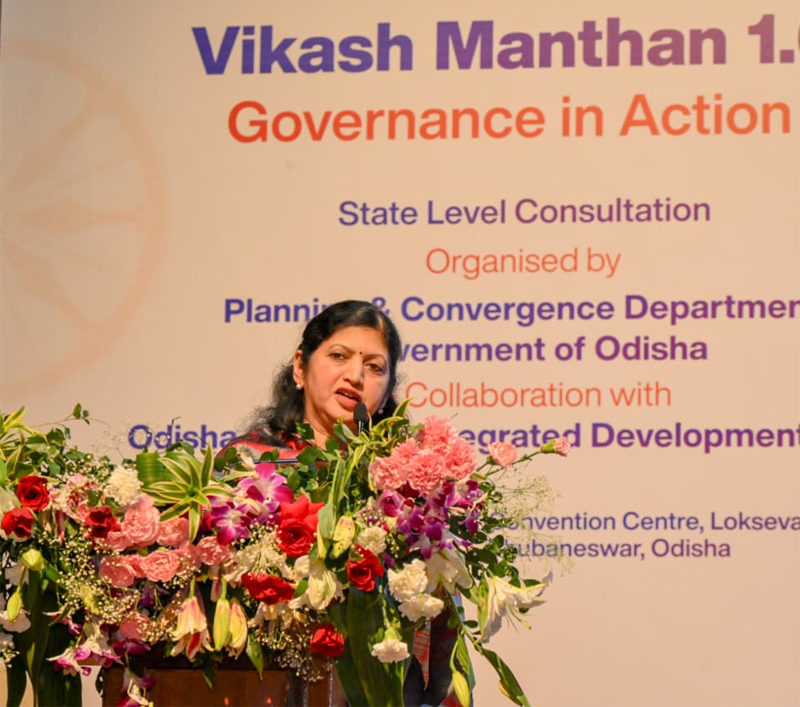
Bhubaneswar, 27 February 2026: The fourth plenary session of Vikash Manthan 1.0 – Governance in Action, titled “Samruddha Odisha”, laid out an ambitious and integrated roadmap to accelerate Odisha’s journey towards a high-growth, future-ready economy. The session brought together senior officers from key departments who deliberated extensively on industry expansion, services-sector transformation, urban reforms, logistics strengthening, and rural economic revitalisation.
The discussions reflected a strong sense of optimism about Odisha’s evolving economic trajectory, while emphasising the importance of focused, time-bound implementation and inter-departmental convergence to translate vision into measurable outcomes.
Addressing the plenary, Smt. Usha Padhee, IAS, Additional Chief Secretary, Housing & Urban Development Department, underscored the critical role of urbanisation as a growth engine for the State. She noted that Odisha’s current urbanisation level stands at approximately 17 percent and stressed the need for calibrated, forward-looking expansion to harness its full economic potential.
Drawing from global examples of urban transformation, Smt. Padhee highlighted the State’s strategic shift from a traditional city-centric development model to an integrated economic-region framework. She emphasised that urban planning must align with long-term economic growth, productivity enhancement, and agglomeration-led development.
In this context, she outlined the contours of the upcoming Livable City Mission, aimed at enhancing urban livability through improved basic services, green public spaces, resilient infrastructure, and citizen-centric governance. The Mission will be complemented by investments in seamless mobility systems and integrated urban infrastructure to create efficient, connected, and inclusive cities.
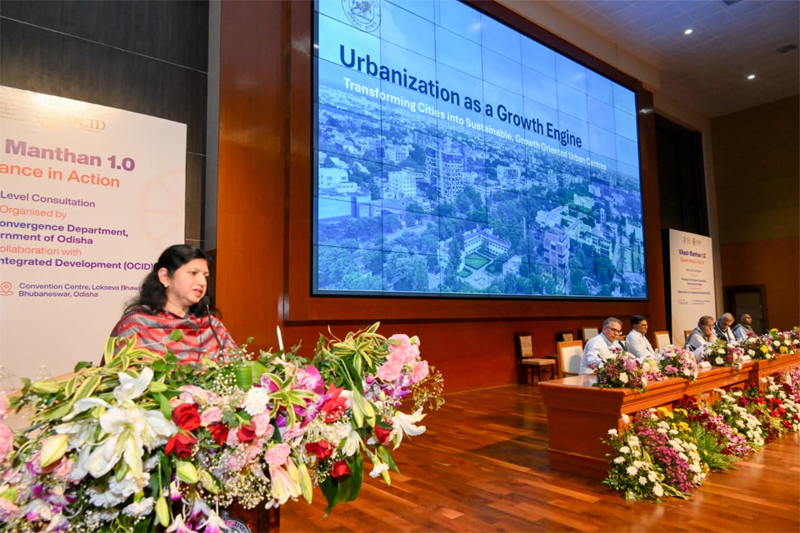
A key highlight of her presentation was the proposed BCPPER (Bhubaneswar–Cuttack–Puri–Paradeep Economic Region), envisioned as a transformative growth corridor for the State. Besides , beyond the coastal growth belt, the State is also conceptualising City Economic Zones in Western and Northern Odisha to ensure balanced regional development. Clusters anchored around Rourkela, Sambalpur and Koraput are being positioned to leverage their strengths in steel, aluminium, agro-processing and mineral-based industries. These emerging economic regions aim to catalyse infrastructure investment, enhance urban services and create large-scale employment opportunities. The initiative reflects the Government’s commitment to transforming growth centres across all parts of Odisha into vibrant engines of economic expansion.The Economic Region is expected to contribute nearly one-third of Odisha’s Gross State Domestic Product (GSDP) in the coming years by leveraging its strategic coastal location, industrial clusters, port-led development, tourism potential, and urban agglomeration advantages.
Smt. Padhee described urbanisation not merely as demographic change but as a strategic economic lever capable of driving industrial competitiveness, services growth, innovation ecosystems, and job creation. She reiterated that coordinated urban investments, supported by policy reforms and institutional strengthening, would be central to achieving sustained and inclusive growth.
The plenary session concluded with a reaffirmation of the Government’s commitment to positioning Odisha as a dynamic economic hub, aligned with the broader vision of building a prosperous and resilient State. Through structured planning, governance innovation, and outcome-oriented execution, “Samruddha Odisha” seeks to translate aspiration into action and growth into shared prosperity.
