

Demographic Change and Legal Systems: Preparing for Emerging Human Futures
- Odisha Govt to Establish Five New Cyber Courts for Speedy Justice in Cybercrime Cases
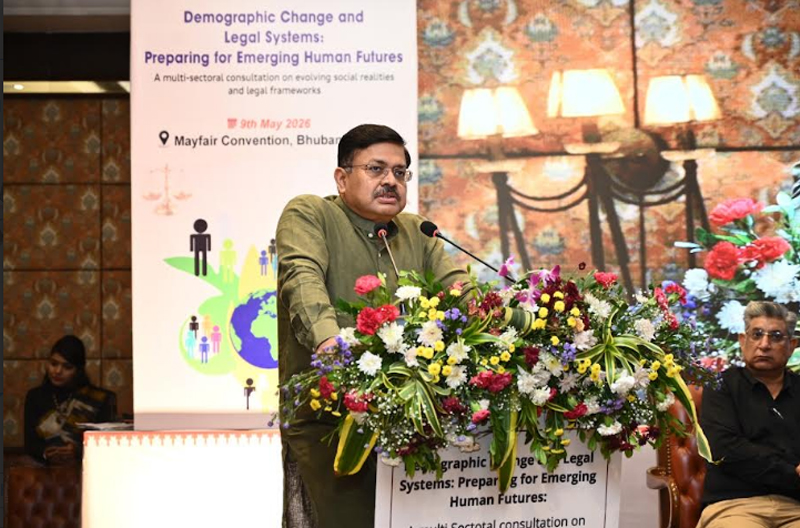
Bhubaneswar, 09.05.2026: In a significant initiative aligned with the vision of Viksit Odisha 2036 and 2047, the Department of Law, Government of Odisha, in collaboration with the United Nations Population Fund (UNFPA), today organised a high-level multi-sectoral consultation on “Demographic Change and Legal Systems: Preparing for Emerging Human Futures” at Mayfair Convention. The consultation focused on how emerging demographic realities—including ageing, changing family structures, declining fertility, adolescent transitions, migration and reproductive technologies—are reshaping governance systems, public institutions and legal frameworks in the state.
The consultation is among the first such initiatives in the country to examine how demographic transition is influencing legal systems, governance institutions and public policy frameworks. It sought to initiate a forward-looking dialogue on preparing legal and institutional systems for emerging social realities arising from demographic change.Inaugurating the consultation, Law Minister Prithviraj Harichandan emphasised that governance systems must increasingly anticipate social change rather than merely respond to it. “As Odisha moves towards Viksit Odisha 2036 and 2047, our legal and institutional systems must remain responsive to changing demographic and social realities. Law cannot remain static when society itself is evolving,” the Minister stated. He appreciated the collaboration between the Department of Law and UNFPA, describing it as a visionary initiative that brings together demographic evidence and legal analysis to support future-ready governance. The Law Minister also emphasized that the Odisha Government is set to establish five new cyber courts to ensure speedy justice in cybercrime cases and seven Fast Track Courts for women will be established to ensure the swift disposal of cases related to crimes against women.
Advocate General, Government of Odisha, Pitambar Acharya, highlighted the growing complexity of legal interpretation in a rapidly changing society. “Courts today are increasingly engaging with issues arising out of changing family structures, care responsibilities and emerging social realities. Discussions during the inaugural session highlighted that demographic transition is not merely altering population structures, but is also influencing how institutions respond to issues relating to ageing, adolescents, caregiving, migration and reproductive choices. Odisha is currently undergoing a rapid demographic transition characterised by declining fertility, increasing life expectancy and a steadily rising elderly population. With fertility levels declining to around 1.7 and family structures changing significantly, the state is witnessing important shifts in age composition and social relationships.
These trends have been highlighted in various demographic analyses and projections of the United Nations Population Fund (UNFPA), the only United Nations agency mandated to work on population and demographic issues globally.Chief Secretary, Odisha, Anu Garg emphasised that demographic transition would play a defining role in shaping the future trajectory of economic, health and social capital under Odisha Vision 2036 and 2047. “Demographic change is not merely about population numbers. It influences families, labour participation, care systems, social protection frameworks and access to justice. Preparing for demographic transition and preparing for Viksit Odisha must go hand in hand,” she stated.The consultation also underscored the importance of anticipatory governance and evidence based institutional responses as Odisha prepares for long-term social transformation arising from demographic shifts. Chairperson, Odisha Law Commission, Justice Biswanath Rath underlined the importance of continuously examining whether legal systems remain aligned with evolving societal realities and emerging vulnerabilities.
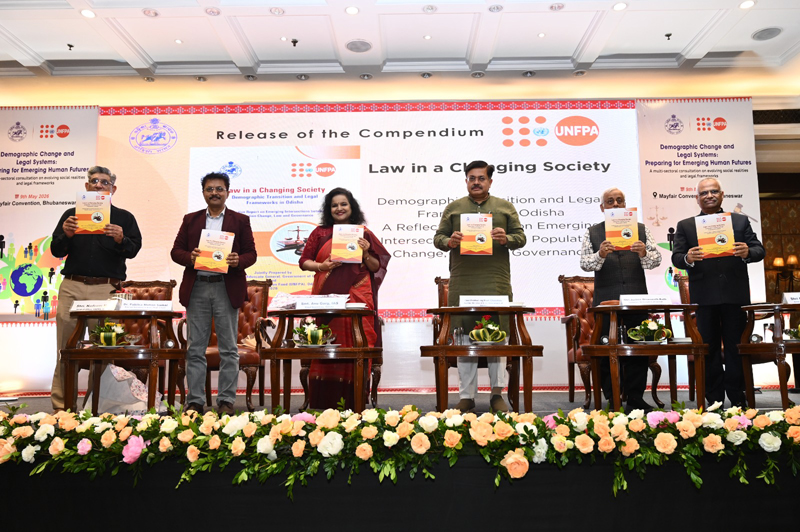
Principal Secretary to Government, Law Department, Pabitra Mohan Samal noted that the initiative marked an important institutional dialogue between law, governance and demographic evidence, and highlighted the need for greater integration between demographic insights and public policy frameworks.Speaking on the occasion, Nadeem Noor, Head of Office, UNFPA Odisha, highlighted the uniqueness of the partnership between the Department of Law and UNFPA in bringing demographic perspectives into legal discourse. “This initiative recognises that demographic transition is fundamentally reshaping how societies function. The analysis of several judicial decisions demonstrates that these shifts are already visible within legal systems and institutional responses,” he stated. A key highlight of the consultation was the release of the reflective compendium titled “Law in a Changing Society: Demographic Transition and Legal Frameworks in Odisha”, which analyses several judicial decisions to examine the intersection between demographic change, governance and legal systems in Odisha.
At this programme, Principal Secretary of the Law Department, Dr. Pabitra Mohan Samal delivered the welcome address. At the end, UNPFA representative Surya Prakash proposed the vote of thanks.The consultation also featured thematic panel discussions involving senior administrators, legal experts, academics and development practitioners on issues relating to ageing, changing family systems, adolescent realities, assisted reproductive technologies, care responsibilities and emerging institutional responses. The event concluded with a shared recognition that demographic transition is not a distant future concern, but a present governance reality that requires continuous dialogue between law, policy and demographic evidence.
