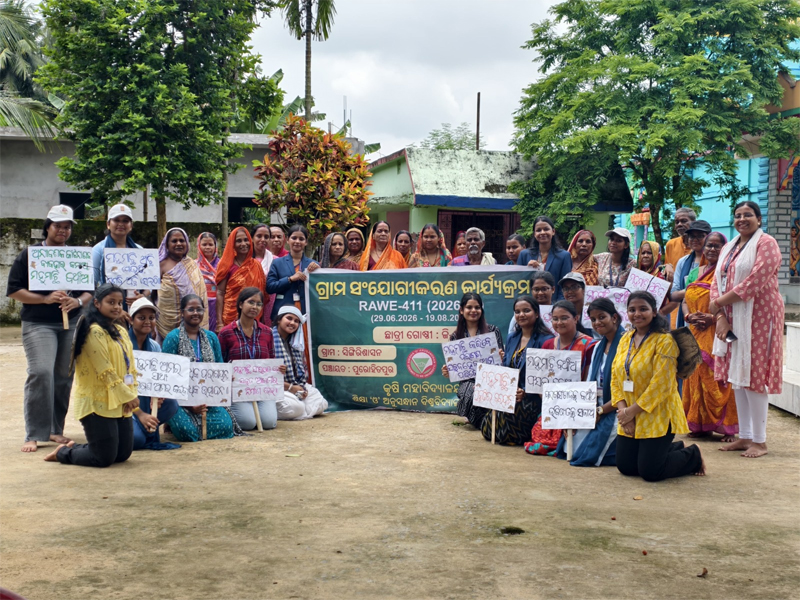
Bhubaneswar, August 6: Reinforcing its commitment to bridging the gap between agricultural research and on-field adoption, Siksha ‘O’ Anusandhan (SOA) Deemed to be University’s t faculty of agricultural sciences Institute of Agricultural Sciences (IAS) successfully organised 16 farmer awareness programmes under the Rural Agricultural Work Experience (RAWE) programme from July 30 to August 6 across 11 adopted villages in Bhubaneswar, Jatni and Balianta blocks of Khordha district.
The awareness programmes were conducted in Jhintisasan, Panikata, Budhipada, Kujimahal,Singirisasan, Puruna Padhan, Chhatabar, Bhola, Barudakhana, Mendhashal and Purohitpur villages with the objective of disseminating scientific agricultural knowledge, promoting sustainable farming practices and strengthening the linkage between agricultural education and rural communities.
Designed to address the emerging challenges confronting farmers—including rising production costs, climate variability, declining soil fertility, water scarcity, and increasing incidence of pests and diseases—the programmes focused on location-specific issues and practical solutions. The themes were carefully selected after assessing local cropping systems, available resources and the specific concerns of farmers, ensuring that the information shared was relevant, need-based and readily applicable in the field.
Adopting an interactive and participatory approach, the campaign went beyond conventional extension activities. Undergraduate agriculture students participating in the RAWE programme actively engaged with farmers through awareness rallies, hand-made placards, slogans, street plays, farmer interactions and door-to-door campaigns, making scientific knowledge more accessible and easier to understand. The initiative not only enhanced farmers’ awareness of improved agricultural practices but also provided students with invaluable field exposure, enabling them to better understand rural farming systems and the practical dimensions of agricultural extension.
The programmes witnessed enthusiastic participation from farmers, women farmers, rural youth and agri-entrepreneurs. Interactive discussions and question-and-answer sessions enabled participants to seek scientific solutions to field-level challenges while encouraging the adoption of improved crop management practices.
Coordinated by the RAWE Committee, the programmes covered a wide range of contemporary agricultural issues, including the safe and judicious use of pesticides, Integrated Pest Management (IPM), Integrated Nutrient Management (INM), balanced fertiliser application, scientific weed management, soil health management, rainwater harvesting, crop diversification, digital agriculture, mobile-based advisory services, conservation of pollinators, management of Parthenium weed, the nutritional importance of fruits and green leafy vegetables, safe handling of agricultural chemicals and various government welfare schemes for farmers. Scientists and faculty members also highlighted climate-resilient farming practices, efficient utilisation of natural resources and cost-effective technologies to enhance farm productivity and sustainability.
Prof. Santosh Kumar Rout, Dean, IAS said that the true value of agricultural research lies in its successful transfer from laboratories to farmers’ fields. He emphasised that the Faculty remains committed to integrating education, research and extension to improve farmers’ livelihoods, strengthen food and nutritional security and promote sustainable agricultural development. He further noted that the RAWE programme plays a vital role in preparing agriculture graduates as competent extension professionals with practical field experience and a deep understanding of rural farming systems.
Dr. Anshuman Jena, Chairman of the RAWE Committee, said every awareness programme was designed after identifying the specific needs of the farming community so that scientific recommendations could effectively address local agricultural challenges. He added that IAS remains committed not only to imparting quality agricultural education but also to empowering farming communities through continuous technology dissemination and field-based extension initiatives.