

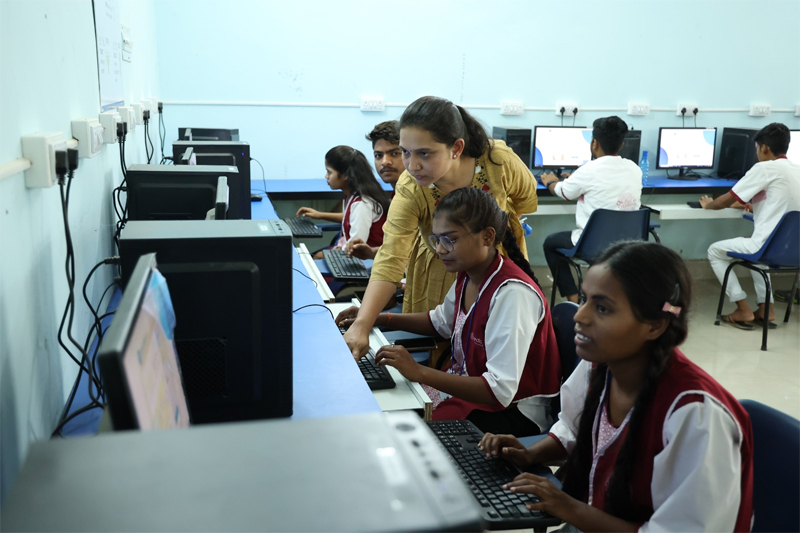
Bhubaneswar: Inside a government school classroom in Odisha’s Kalahandi district, a group of curious students watch a complex scientific concept come alive vividly on a large digital screen. Topics that were once confined to chalk diagrams and rote explanations in textare now visually engaging, and easier to grasp.This shift from passive learning to active engagement, made possible through Vedanta Aluminium’s support, is transforming classrooms across rural Odisha.
In districts like Kalahandi,Sundargarh and Jharsuguda, where literacy levels are at around 59%, 73% and nearly 79% respectively(as per the 2011 census), large sections of students are first-generation learners, and educational access in these regions has been largely characterised by limited teacher availability, weak foundational learning, and low classroom engagement. In such a context, learning outcomes are shaped less by access to schools and more by the quality of instruction within them.
Vedanta Aluminium has been working to address this gap through a phased approach, first strengthening classroom-based teaching, and then augmenting it through digital learning tools, ensuring that technology strengthens rather than replaces strong academic foundations.
Vedanta Aluminium has launched Project Gyan Jyoti in the Sijimali region across Rayagada and Kalahandi districts, in collaboration with Aveti Learning. Covering 6government schools and benefiting over 600 students, the initiative is supporting learning through digital classrooms, solar-powered infrastructure,and community engagement, helping improve access to quality learning environments in remote rural areas of Odisha.
Under Project Vidya, launched in 2025, the company’s focus has been on improving teacher-student ratios and strengthening core subject learning in Mathematics, Science, and English. Through the deployment of 20 additional teachers across 17 government schools, the initiative has supported over 1,800 students across Sundargarh and Jharsuguda.
The impact has been immediate and measurable. Attendance in intervention areas has increased from 64% to 76% in Lakhanpur block and 66% to 82% in Hemgir block, while overall student achievement has improved from 42% to 64%. Targeted academic support through reference books, is also helping students access opportunities beyond their immediate geography.
In regions where many children are the first in their families to attend school, this progress is also driving change at the household level. Regular attendance, improved learning, and structured guidance are reshaping how families view educationas a pathway to opportunity.
Binita Soren, a parent from Hemgir,reflected on this shift, saying, “Earlier, we only wanted our children to go to school. Now we want them to study well, acquire a good education, and move ahead in life. Vedanta’s projects have made a difference in how confidently they learn and speak.”
Layering Digital Learning for Scale and Access
Building on this robustfoundation, Project Vidyagraha in Jharsuguda has introduced digital learning as an enabler.
Designed as a hybrid model, the initiative combines pre-recorded lessons, app-based access, and in-person doubt-clearing sessions, extending learning beyond classroom hours. Covering 106 government high schools and reaching over 12,000 students, it allows learners to revisit concepts, study at their own pace, and prepare more effectively for board examinations.
The engagement reflects this shift, with over 26,000 content views on the learning platform, indicating increasing adoption of digital tools among students who previously had limited exposure to structured e-learning.
Importantly, the intervention goes beyond academics. Through career counselling, life skills sessions, and employee volunteering, the programme is helping students build awareness around subject choices, career pathways, and future opportunities, areas often inaccessible in rural schooling environments.
For students, the change is visible in their performance, as well as confidence levels.
Kunti Kumari, the mother of a Class 10 student from Jharsuguda shared, “Earlier, my son would struggle to understand concepts in Science. With the videos and sessions, he is able togo back home and revise again. It makes him feel more prepared for exams.”
Teachers report similar shifts. “Students feel more engaged now. They participate more and ask questions. It has made classrooms more interactive,”said, Purna Chandra Sahu, a teacher associated with the programme.
Why This Model Matters
In regions across rural Odisha, digital tools alone cannot drive outcomes without strong teaching support. By addressing foundational gaps through teacher deployment and academic strengthening, and then layering digital learning for reinforcement and scale, the model ensures more sustainable impact.It enables consistent quality of content, reinforces classroom learning, expands exposure to concepts and careers, and improves retention.
The impact of these interventions extends beyond academics. For many students, this is their first exposure to structured learning support, digital tools, and defined career pathways. In turn, this is gradually reshaping aspirations, not just for students, but for their families as well.By combining strong teaching support with digital enablement, Vedanta Aluminium is helping build a layerededucation ecosystem where students are better equipped to learn and grow.
