

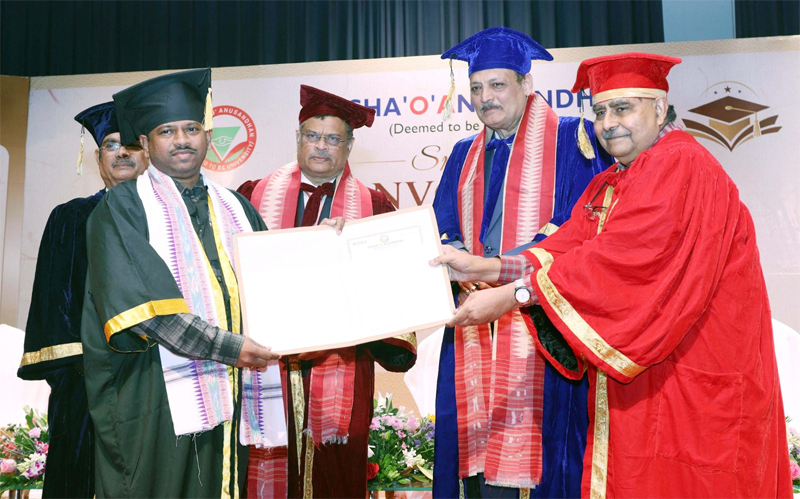
SOA’S SPECIAL CONVOCATION
Bhubaneswar, July 18: Advancement in technology and the advent of Artificial Intelligence may have enhanced efficiency in the functioning of courts but it cannot be a substitute for conscious compassion and independent legal reasoning, Mr. Justice Harish Tandon, Chief Justice of the High Court of Orissa, said on Saturday.
The development has triggered a paradigm shift in conventional court practice but it can never replace human judgment, Mr. Justice Tandon said while addressing a Special Convocation conducted by the Siksha ‘O’ Anusandhan Deemed to be University (SOA) as the chief guest.
“I am not averse to technology as it improves efficiency and helps process information at jet speed but it cannot replace compassion and reasoning,” he said before Ph.D degrees were conferred on more than 300 doctoral candidates.
The university also conferred the honorary degree of Doctor of Laws (Honoris Causa) on Mr. Justice Krishna Shripad Dixit, Judge of High Court of Orissa on the occasion. Fifteen Judges of the High Court of Orissa and five judges from the Karnataka High Court attended the academic ceremony.
Prof. (Dr.) Amit Banerjee, Chancellor of the University, presided over the function while Prof. Pradipta Kumar Nanda, Vice-Chancellor, presented the report.
Stating that the true measure of the society was founded on the fairness of its laws, Mr. Justice Tandon said that the rule of law was not an abstract version but encompassed its morality, integrity and transparency in pursuit of achieving the avowed objective largely founded on the dispensation of justice.

“The constitutional morality is the guiding elixir to sustain the federal system preserving and protecting the meaningful life to the ideals embedded therein. It constantly reminds us such progress could be anchored in fairness, dignity and accountability,” he said.
“The true strength of our republic lay not merely on various articles incorporated in the constitution but in the commitment of those entrusted with its implementation,” Mr. Justice Tandon said while referring to a judgment of former Chief Justice of India Mr. Justice D.Y. Chandrachud in the Santosh Singh vs Union of India.
In the order, Mr. Justice Chandrachud had defined morality as just one element in the composition of values that a just society may pursue. He underscored the need for acceptance of plurality and diversity of ideas which faced global threats, Mr. Justice Tandon said.
Tolerance for those who hold radically different views and empathy for those whom the economic and social milieu has cast away to the margins are important values that a just society could pursue, he said while stating that this view was the reiteration and reaffirmation of Dr. B.R. Ambedkar’s address to the Constituent Assembly on November 4, 1948.
Addressing the students of legal studies, Mr. Justice Tandon said the advocates had a duty to the court which was permanent. “It is a mistake to suppose that the lawyer is merely the mouthpiece of his client and speak what he pleases. His primary duty is to uphold the law as morality and ethics were twin siblings and served as the foundation of the profession,” he said.

Mr. Justice Dixit, who was the guest of honour at the convocation, praised SOA Deemed to be University saying it would join the list of great universities soon.
Mr. Justice Dixit said that the budgetary allocation for research was not satisfactory in India while describing it as ‘abysmally low’. Citing the example of Israel, he said after the country came into existence in 1948 its first prime minister Ben Gurion invited Jewish scholars from all over the world to return to Israel to help it rise.
Prof. (Dr.) Banerjee, in his address, congratulated the scholars receiving their Ph.D degrees while underlining the need to cultivate legal literacy as no significant scholarship existed in isolation of the law. “While knowledge informed us what is possible and wisdom told us what is desirable, legal literacy helped us understand what is permissible, responsible and just,” he said.

The Vice-Chancellor Prof. Nanda spoke about the progress made by the university over the last two decades saying it had emerged as a centre of quality education and focused research. The university’s researchers were presently working in 18 research centres which were working in 27 identified thrust areas aligned with national priorities, he said.
SOA, Prof. Nanda said, had set up two medical colleges and two hospitals including one in Berhampur which had emerged as preferred healthcare centres in Odisha and neighbouring states. He also spoke about the five stand alone Covid hospitals the university had set up across the state after the outbreak of the pandemic which had treated more than 50,000 patients.
Prof. Bibhuti Bhushan Pradhan, Pro-Vice Chancellor and Registrar of the university, Prof. Manjula Das, Controller of Examination, Prof. Jayanta Nath, Dean (Research and Development) and Prof. Jyoti Ranjan Das, Dean (Students’ Welfare) conducted the proceedings.
